The Map That Promises More Than It Shows
A casino map can show routes and landmarks, but not a room’s feel. Learn to read its symbols, check its limits and plan a clearer route.
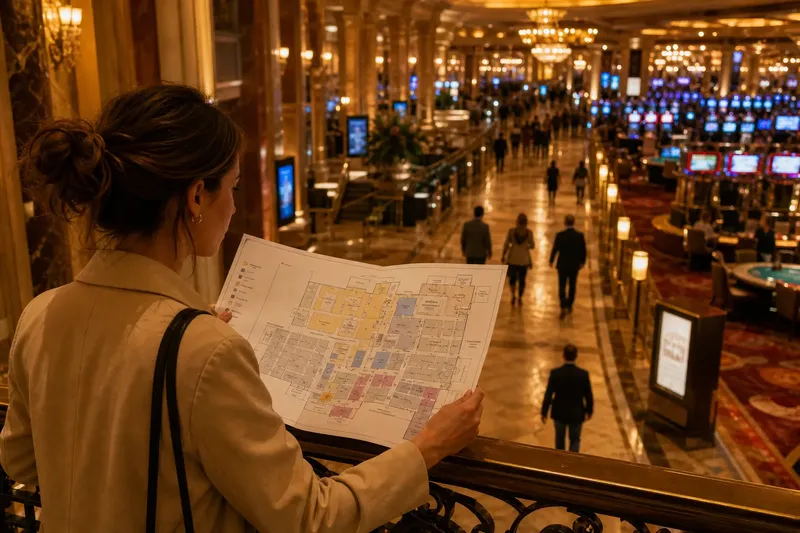
A casino map can show the route to a restaurant, but it cannot tell you whether the corridor is lively or quiet. Reading a casino map well means separating orientation—where things are—from atmosphere, the sensory character of the space.
That distinction matters before you set out. A neat block marked “gaming” may stand for a lively hall, a quieter room or several connected areas. Use the map to find your bearings, then check other clues about the experience you can expect.
Check the map’s scope
Before tracing a route, check what kind of map you have. A printed directory, a phone-screen floor plan and an event map may show the same building differently. One may prioritise restaurants and lifts; another may highlight temporary closures or event entrances.
Look for a title, date or note explaining the map’s scope. Does it cover one floor, a hotel complex or the entire resort? Are nearby venues shown as part of the same property, or simply as landmarks? A map that omits a section may be selective rather than inaccurate.
Locate the legend and north marker, if present. Symbols for toilets, lifts, stairs, accessible routes and information points are more useful than decorative icons. If a colour key is unclear, do not assume that a shaded area represents a particular mood or level of activity.
Use the map first to establish its boundaries and symbols, not to judge the room.
Locate start and destination
Identify a reliable starting point: the entrance you plan to use, a lift lobby or a clearly named reception point. “You are here” markers can be misplaced on older printouts, so compare nearby labels with signs you can see in the building.
Next, find the destination by its exact name. Casino maps may use broad labels such as “gaming floor”, while on-site signs use a named room or entrance. If the wording differs, check a directory or ask a staff member before committing to a route.
Trace the route through landmarks rather than relying on a straight line. A corridor, bridge, lift bank or atrium can form a useful sequence. Note where the path changes level, passes through a controlled entrance or appears to depend on access that may not be available to every visitor.
Say you are meeting someone at a restaurant marked on a resort map, but its entrance sits beyond a hotel lift lobby. Following the map’s line may bring you to the building but not the right doorway. Matching the restaurant name to nearby signs gives you a clearer meeting point.
Notice what maps omit
A map is a selective picture. It usually simplifies corridor widths, furniture, guest numbers and visual distractions. It may leave out queues, temporary barriers, service doors and changes made for an event.
Notice what the map is designed to emphasise. A guest directory may make dining and entertainment easy to find while presenting circulation space as blank connecting lines. A fire or access plan may give more attention to exits and routes. Neither is a complete portrait of what a visitor will see.
Blank space is especially easy to misread. It may indicate an unlabelled hall, a private area, a gap between buildings or simply a graphic choice. Do not infer quietness, openness or privacy from the absence of symbols.
For practical details the map leaves out, check current venue information or ask a member of staff.
Separate route from atmosphere
Orientation answers questions such as “Which way is the lift?” and “How do I reach the restaurant?” Atmosphere concerns a different set of impressions: sound, lighting, visual density, pace and the way one area opens into another. A floor plan can hint at some of these, but it cannot deliver them.
Use visual clues cautiously. A large room outline might suggest generous floor area, yet not show how much is occupied by machines, tables or temporary installations. A direct route on paper may pass through a crowded central space; a longer corridor may feel calmer, but the map alone cannot establish that.
Venue photographs, room descriptions and accessibility information can add context, though each has limits. Photographs frame a particular angle and moment. Descriptions often focus on amenities. If atmosphere will shape your plans, treat those sources as clues rather than promises, and ask the venue about the specific feature that matters to you.
Choose a route for clarity first; judge the room’s character from evidence beyond the map.
Questions about casino maps?
Can a map show how busy a casino will feel?
No. A map may mark the size and position of a gaming area, but it does not show guest numbers or how sound carries. Check current venue guidance if crowd levels affect your plans.
Does a larger room outline mean a quieter space?
Not necessarily. Room size says little about activity, acoustics or how the space is divided. Check the room’s description and ask about the particular conditions you care about.
What if the map and signs disagree?
Follow current on-site signs or ask staff, especially if the route involves a closed entrance or changed access point. The map may be out of date or designed for a different part of the property.
Can a map tell me whether a route is accessible?
It may identify lifts, ramps or step-free paths, but the detail varies. Check the venue’s accessibility information for the route and destination you need, and contact the venue if an important detail remains unclear.
Plan with useful checks
Before setting out, use these checks to decide whether the map is enough or whether you need current information or staff guidance:
- Check the map title and date; if it covers the right property and appears current, use it to plan, but if either is unclear, confirm the route with the venue.
- Check the starting point against visible signs; if the entrance or lift lobby matches, begin there, but if it does not, use a confirmed landmark instead.
- Check the destination’s exact name; if it matches the directory or signs, follow that label, but if names differ, ask staff which entrance serves it.
- Check the legend for lifts, stairs and step-free routes; if the symbols identify the access you need, trace that route, but if they do not, consult the venue’s accessibility information.
- Check for a level change or controlled entrance; if the route is clearly available to you, continue, but if access is uncertain, confirm before setting out.
- Check for signs of temporary changes, such as a closure notice or event entrance; if none appear and the map agrees with current signs, follow it, but if they conflict, follow on-site guidance or ask staff.
- Check whether the meeting point is a named public landmark; if it is easy to identify, share that name, but if it is vague, agree on a clearer point such as reception or a named entrance.
Imagine you have a map labelled for the whole resort, a restaurant name that differs slightly from the directory, and a route passing through a hotel lift lobby. You compare the map’s starting entrance with the sign in front of you; they match, so you keep that starting point. You check the legend and see a lift symbol, but no clear step-free link to the restaurant level, so you do not assume the route is accessible. You ask staff, who direct you to a named entrance beyond the lobby. The result is a specific meeting point and a route confirmed against current information, rather than a guess based on the map’s line.
For a meeting, name a recognisable public point rather than a vague zone such as “near the gaming floor”. For a meal or show, confirm the venue name and entrance, particularly if the complex contains similarly named rooms. If you need step-free access, verify the route before setting off instead of assuming the nearest lift serves every level.
A casino map is most useful when you ask it a modest question: where can I go from here? For a sense of what that place will be like, combine the casino map with current descriptions, signs and direct information from the venue. A quick check of the entrance and destination name can prevent a clear route from ending at the wrong door.